GLP-1 Drugs and Addiction: What the Research Shows on Alcohol, Smoking, and Other Compulsive Behaviours
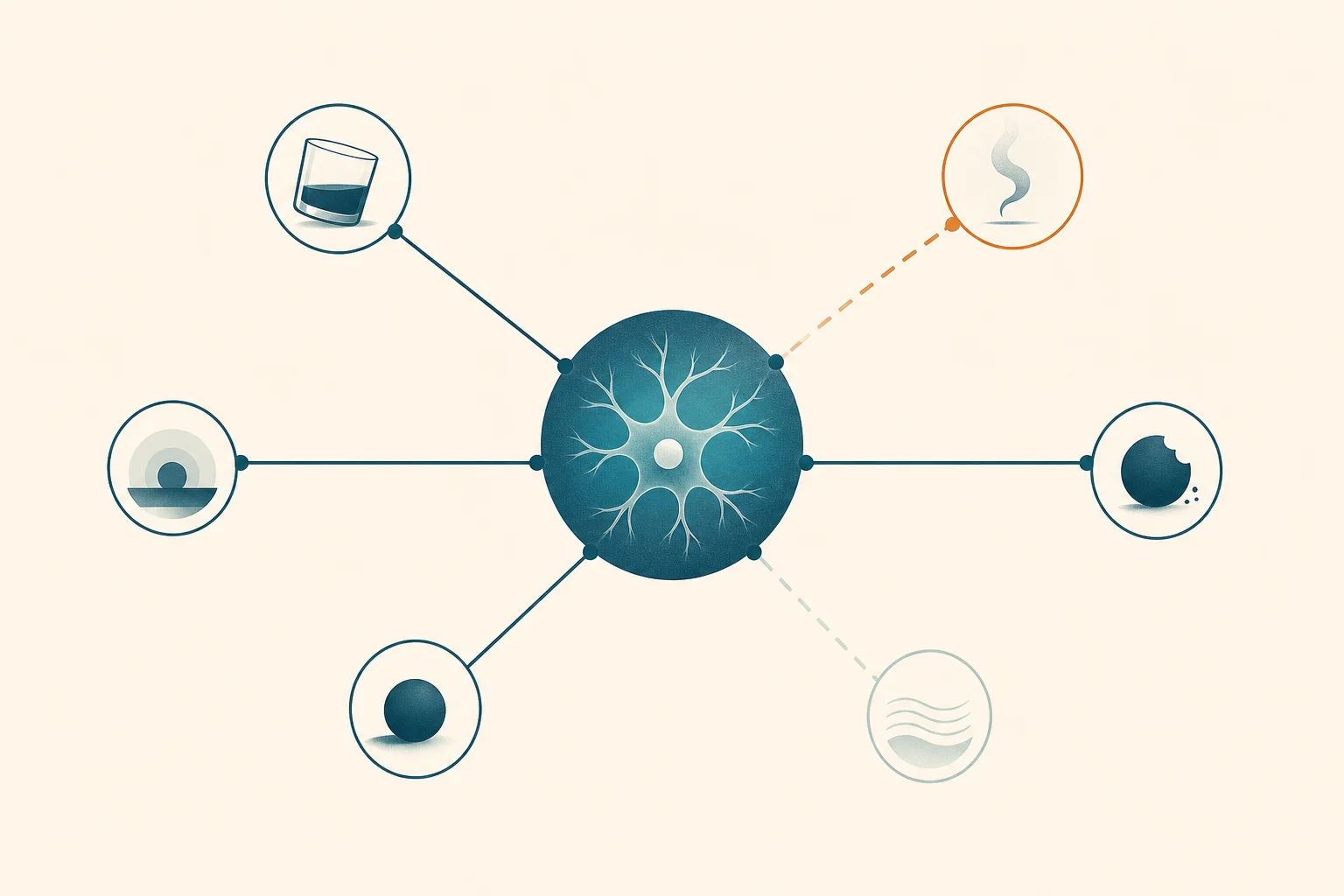
The unexpected reports that started the research
Before formal trials examined addiction outcomes, patients began reporting surprising changes in patient communities and to their prescribers:
- "I don't want to drink anymore"
- "I quit smoking without trying"
- "I've stopped binge-watching TV and I'm not sure why"
- "My online shopping is gone — I just don't feel the urge"
These were not isolated anecdotes. They clustered across GLP-1 drug users in a pattern that attracted scientific attention. By 2022–23, several research groups had begun investigating whether GLP-1 receptor agonism has effects on brain reward circuits beyond food intake regulation.
The short answer from emerging evidence: yes, it does.
Why GLP-1 drugs might affect addiction: the neuroscience
GLP-1 receptors are expressed in several brain regions involved in reward processing and reinforcement learning:
- Ventral tegmental area (VTA): The nucleus of the dopamine reward system. GLP-1 receptor activation in the VTA reduces dopamine release in response to rewards — including food, alcohol, drugs, and other reinforcing stimuli.
- Nucleus accumbens: The "reward hub" where dopamine from the VTA acts to create wanting and motivation for reward. GLP-1 agonism modulates activity here.
- Prefrontal cortex: Executive function and impulse control. GLP-1 receptors in prefrontal circuits may improve impulse regulation.
- Amygdala: Processes fear, anxiety, and stress-driven behaviours. GLP-1 activity here may reduce stress-driven compulsive eating and other stress-triggered behaviours.
The proposed mechanism across addictive substances is consistent: GLP-1 receptor activation dampens the dopaminergic response to the reward, reducing both craving and the reinforcement value of the behaviour.
Alcohol use disorder: the strongest evidence
Animal studies have consistently shown that GLP-1 agonists reduce alcohol intake in rodent models of alcohol use disorder. The mechanism involves reduced dopamine release in response to alcohol consumption — the drug makes drinking less rewarding.
Human trials:
A randomised, placebo-controlled trial published in JCI Insight (2023) tested semaglutide in 48 adults with alcohol use disorder. Semaglutide significantly reduced:
- Total alcohol consumed per week
- Heavy drinking days (defined as more than 4 drinks/day for women, more than 5 for men)
- Craving scores on validated instruments
A secondary analysis of the SELECT cardiovascular outcomes trial found that semaglutide patients reported significantly lower rates of alcohol use disorder events compared to placebo — though this was not a primary endpoint and interpretation requires caution.
Ongoing trials: Several Phase 2/3 trials specifically testing GLP-1 agonists (semaglutide, tirzepatide, exenatide) for alcohol use disorder are underway as of 2025. This is an active FDA priority.
Current clinical implications: GLP-1 drugs are not FDA-approved for alcohol use disorder. Off-label use is not standard care. Patients who notice reduced alcohol intake or craving on GLP-1 therapy for obesity should not interpret this as a treatment for alcohol use disorder without discussing it with a clinician.
Nicotine and smoking cessation
Animal studies show reduced nicotine self-administration in rats treated with GLP-1 agonists. The proposed mechanism is similar to the alcohol mechanism: reduced dopaminergic reward from nicotine.
Human observational data: Several large database analyses have found that GLP-1 users have significantly higher smoking cessation rates compared to matched controls. A 2024 analysis of a UK primary care database found semaglutide users were 54% more likely to have quit smoking at 12 months than comparable patients not on GLP-1 therapy.
Caveats: Observational data is subject to confounding. Patients starting GLP-1 therapy may be more motivated for health behaviour change generally.
Ongoing trials: At least two RCTs are underway specifically testing varenicline (Champix/Chantix) plus semaglutide versus varenicline alone for smoking cessation. Results expected 2025–2026.
Gambling, shopping, and other compulsive behaviours
Case reports and patient-reported outcomes describe reductions in:
- Problem gambling
- Compulsive online shopping
- Nail-biting and skin-picking (body-focused repetitive behaviours)
- Binge television watching
- Social media use
These are anecdotal and not yet studied systematically. The common thread in the patient reports is a reduction in "noise" or "wanting" — patients describe the urges as quieted rather than forcibly suppressed.
The mechanism would be the same reward-circuit dampening proposed for food, alcohol, and nicotine — but evidence for these specific behaviours is limited to case reports and patient community observations.
The "food noise" connection
GLP-1 patients frequently use the term "food noise" to describe the constant mental preoccupation with food that disappears on therapy. The reduction in food noise is among the most consistently reported and transformative aspects of GLP-1 treatment.
The research on alcohol, nicotine, and other compulsive behaviours suggests that "food noise" is a manifestation of the same underlying reward circuit hyperactivity that drives other addictive behaviours. GLP-1 receptor activation in reward circuits reduces the "noise" of reward anticipation and craving across multiple domains — food being the most prominent because it is the most frequent.
For patients who had concurrent compulsive eating and other compulsive or addictive behaviours, this broader reward-dampening effect may explain why GLP-1 therapy sometimes feels like a personality shift rather than just a diet intervention.
Clinical and ethical considerations
Positive implications: The addiction research raises the possibility that GLP-1 drugs could be used as a treatment for substance use disorders — a major unmet need. If RCT evidence confirms efficacy for alcohol use disorder specifically, FDA approval could follow.
Caution for patients with addiction history: The reward-dampening mechanism means some patients may find GLP-1 therapy removes rewarding experiences beyond food — music, social interaction, or previously enjoyed activities may feel less pleasurable. This is an uncommon but reported phenomenon (sometimes called anhedonia) and should be reported to a prescriber if it occurs.
Not a substitute for addiction treatment: The preliminary evidence is promising but not sufficient to recommend off-label GLP-1 prescribing for substance use disorders. Patients with active alcohol use disorder or drug dependence should receive evidence-based addiction treatment; GLP-1 therapy for co-morbid obesity is not a substitute.
Summary
GLP-1 receptor activation in brain reward circuits — particularly the VTA-nucleus accumbens dopamine pathway — appears to reduce the rewarding and craving properties of multiple addictive substances and compulsive behaviours. The evidence is strongest for alcohol (RCT data) and nicotine (large observational data); data for gambling and other behaviours is limited to anecdotal reports. These findings align mechanistically with what patients report about "food noise" reduction. Formal addiction indications are under investigation but not yet FDA-approved.
This article is queued for review by a medical doctor. It should not be used as personal medical advice.
Part of GLP-1 Benefits Beyond Weight Loss — the evidence for GLP-1 drugs across heart, kidney, metabolic, and other outcomes.