Weight Regain After Stopping GLP-1 Drugs: Trial Data, Mechanism, and What Predicts Who Keeps the Weight Off
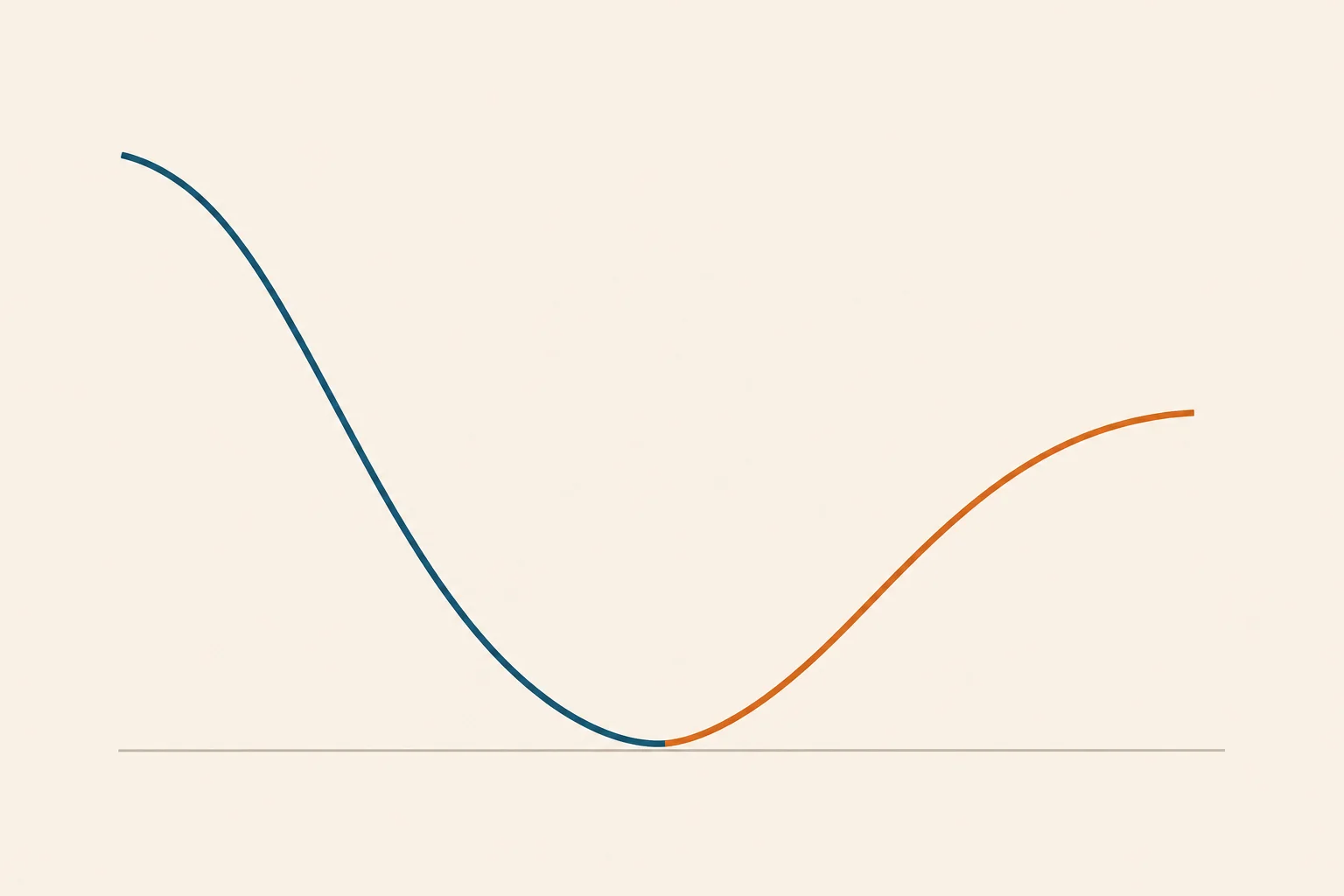
When a GLP-1 drug is stopped, the body does not maintain the weight-loss state the drug created. It returns to the hormonal baseline that existed before the drug — and that baseline, for most people with obesity, is one that defends against weight loss.
Understanding why regain happens, and what the trial data shows about its magnitude, matters both for people who are about to stop and for people who are trying to make sense of their experience after stopping.
What the trial data shows
STEP 1 extension: semaglutide
The STEP 1 trial tested semaglutide 2.4 mg weekly versus placebo in adults with obesity without T2D over 68 weeks. The treatment arm achieved a mean 17.3% body weight loss. Participants then entered a 52-week off-treatment extension, with both groups discontinuing their assigned treatment.
At the 52-week follow-up after stopping (Wilding et al., 2022):
- Former semaglutide patients had regained a mean 11.6 percentage points of body weight — approximately two-thirds of what they had lost
- Net weight change from original baseline: −5.6% (versus −17.3% at peak)
- Cardiometabolic improvements (waist circumference, blood pressure, HbA1c, lipids) reversed in proportion to weight regained
- 48% still maintained ≥5% weight loss from baseline — so not everyone rebounded fully
The recovery curve was not flat. Most regain occurred in the first six months; the rate slowed in months six through twelve. Researchers estimated the trajectory would approach baseline weight within approximately 1.7 years without further intervention.
SURMOUNT-4: tirzepatide
SURMOUNT-4 followed the same design for tirzepatide, with an open-label run-in period to weight stabilisation, then randomisation to continue tirzepatide at maximum tolerated dose or switch to placebo for 52 weeks.
Results at 52 weeks:
- Placebo (withdrawal) group: regained approximately 14 percentage points of body weight
- 82% of patients who stopped regained more than 25% of their initial tirzepatide-induced loss
- Continued tirzepatide group: lost an additional 6.7% on top of their run-in loss
- Same pattern of cardiometabolic reversal proportional to weight regained
The combined picture from these two trials: stopping a GLP-1 drug produces substantial, rapid regain in the majority of patients, with the average trajectory returning toward baseline within 1–2 years.
Why the weight returns: the mechanism
The regain is not a failure of willpower. It is a predictable physiological response to removing a drug that was substituting for impaired hormonal signalling.
Ghrelin — the hormone that drives hunger, normally suppressed on GLP-1 therapy — rises when the drug clears. Patients who described "I forgot to eat" on the drug report food noise returning within days of missing doses.
Leptin signalling, which contributes to satiety, falls as fat mass decreases and drug-mediated enhancement ends. The hypothalamic circuits that process satiety are receiving less signal from both directions.
Resting metabolic rate adapts downward during weight loss — the "metabolic penalty" of having lost weight that researchers have documented for decades. This adaptation persists after stopping the drug: the body is burning fewer calories than before, while appetite has returned to its full pre-drug level. The combination of restored hunger and suppressed metabolism creates conditions for rapid regain.
Food reward-circuit reactivation: GLP-1 and GIP receptors in the brain modulate dopaminergic food-reward pathways. On tirzepatide especially, patients report a qualitative dampening of the hedonic drive to eat — "food just doesn't interest me the way it did." When the drug clears, this circuit reactivates. The desire to eat returns not as gradual drift but as a measurable neurological event.
Body composition ratchet: Weight loss on GLP-1s includes approximately 30–40% lean mass alongside fat loss. Regained weight is predominantly fat. If a patient loses 20 kg (30% lean mass), then regains 15 kg (predominantly fat), their body composition is worse at the same scale number than before starting — more fat, less muscle, lower resting metabolic rate. Each cycle worsens the composition.
Who maintains weight after stopping
The STEP 1 extension's finding that 48% maintained ≥5% loss at 12 months is meaningful: the average hides real individual variation. Some patients maintain substantially more than 5%.
The literature on long-term weight maintenance off pharmacotherapy is thin and largely observational. From what exists, and from extrapolation from the broader weight-maintenance literature, the pattern of patients who maintain more loss tends to include:
Sustained dietary quality: Patients who used the on-drug period to restructure eating patterns — not just eat less while appetite was suppressed, but develop new habits — appear more likely to maintain. The drug provides a window; the habits provide the floor.
Resistance training: Preserving lean mass during the weight-loss phase protects resting metabolic rate. Patients who built resistance training into their routine during drug therapy have a mechanical advantage during maintenance.
Daily weighing: National Weight Control Registry data on patients maintaining ≥30 lb of loss for 6+ years identifies daily or near-daily self-weighing as one of the strongest single behavioural correlates of maintenance. Early detection of weight drift — a 2–3 lb return — allows a behavioural response before the trajectory becomes hard to reverse.
Access to re-treatment: Patients who know they can restart the drug if significant regain occurs appear to approach maintenance differently. The knowledge that a return to treatment is accessible reduces the stakes of temporary drift.
None of these factors prevents regain with certainty. They shift the probability distribution.
The chronic disease framing
The WHO issued its first guideline on GLP-1 drugs for obesity in December 2025, with a conditional recommendation supporting use in adults with BMI ≥30 — and explicitly framing obesity as a chronic condition requiring long-term management. The AACE (American Association of Clinical Endocrinology) 2025 algorithm positions the same way.
The statin analogy is explicit in this literature: stopping a statin when LDL normalises does not make clinical sense because the drug is managing an ongoing condition, not curing it. The same logic applies to GLP-1 therapy and body weight for most patients. The drug is substituting for impaired metabolic signalling that does not permanently correct with weight loss alone.
The practical implication of this framing: for patients who have responded well to GLP-1 therapy and want to maintain the benefit, the clinical question is not "how do I come off the drug" but "what is the right ongoing dose for long-term management." SURMOUNT-MAINTAIN showed that tirzepatide 5 mg (below most patients' maximum therapeutic dose) held approximately 70% of peak weight loss versus placebo at 112 weeks — suggesting a maintained low-dose strategy as an alternative to discontinuation.
The insurance and cost reality
The clinical consensus on long-term treatment runs into a structural problem: most insurance plans do not cover GLP-1s for obesity indefinitely, and many cover them not at all.
Cost-driven discontinuation — patients stopping because coverage lapses or cost becomes prohibitive — is the most common real-world cause of the weight-regain pattern described in this article. It is not medically planned; it is financially forced. The patient who loses 20 kg on semaglutide and then loses insurance coverage is undergoing an involuntary "clinical trial" of what happens when a chronic-disease drug is withdrawn for non-clinical reasons.
The Medicare GLP-1 Bridge (effective July 2026, Zepbound KwikPen at $50/month for qualifying patients) addresses one segment of this gap. It is an 18-month demonstration, not a permanent coverage decision.
For patients navigating cost-driven discontinuation, the full discussion of options is in the GLP-1 access without insurance guide and the cash-pay platform comparison. And if the discontinuation was specifically a cancelled compounded prescription, our guide to every continuation path lays out all five before the regain clock starts. If you are being priced off and deciding how to come off as safely as possible, see stopping a GLP-1 because it's too expensive.
What this means practically
Stopping a GLP-1 drug is a high-regain-risk event for most people, and the mechanism is biological rather than behavioural. If stopping is being considered:
- The conversation with the prescriber should include what the plan is for the weight, not just how to exit the drug
- A transition to a lower maintenance dose, rather than full cessation, is the best-evidence approach for patients who can manage the ongoing cost
- If full cessation is necessary (financial, medical, pregnancy), establishing the behavioural infrastructure before stopping — not after — gives the best odds of partial maintenance
This article is awaiting medical-reviewer signoff. It describes published trial data and current clinical frameworks; it does not constitute medical advice. Any decision about stopping, tapering, or adjusting GLP-1 therapy should be made with your prescriber.
Frequently asked questions
How much weight do people regain after stopping Ozempic or Wegovy?
In the STEP 1 trial extension, participants who stopped semaglutide 2.4 mg regained a mean 11.6 percentage points of body weight within 52 weeks — approximately two-thirds of what they had lost. At the one-year mark, 48% still maintained at least 5% weight loss from baseline. SURMOUNT-4 found similar results for tirzepatide: 82% of patients who stopped regained more than 25% of their initial loss within one year.
Is weight regain after GLP-1 drugs inevitable?
Not for every individual, but it is the strong statistical tendency. Population-average regain in the controlled trials is large — two-thirds of lost weight in 12 months for semaglutide. Some patients maintain most of their loss, particularly those with sustained high-quality diet and exercise habits. The biology is working against maintenance: the hormonal state the drug suppressed returns when the drug is removed.
Why does weight come back after stopping a GLP-1 drug?
GLP-1 drugs suppress ghrelin (hunger hormone), enhance leptin signalling (satiety), slow gastric emptying, and reduce food reward-circuit activation. When the drug clears, these effects reverse: ghrelin rises, leptin falls, food noise returns, and appetite-regulation returns to the pre-drug state. Resting metabolic rate, which adapts downward during weight loss, remains suppressed even after stopping — meaning the body is burning fewer calories than before while appetite has returned to its prior level.
Is stopping a GLP-1 like stopping a statin?
The analogy is frequently used in obesity medicine and has clinical validity. When a statin is stopped, cholesterol returns toward its prior level because the statin was managing a chronic metabolic condition, not curing it. The same applies here: GLP-1 drugs manage a chronic hormonal and metabolic state that reasserts itself when the drug is removed. WHO and AACE guidelines as of 2025 explicitly frame GLP-1 therapy this way — as long-term management of a chronic disease.
Do cardiometabolic benefits (blood pressure, HbA1c) reverse when weight is regained?
Yes, in proportion to weight regained. SURMOUNT-4 post-hoc analysis showed blood pressure, HbA1c, waist circumference, and lipid improvements reversed approximately in proportion to how much weight returned. For patients who regained most of their lost weight, the cardiometabolic benefit was largely lost. For patients who maintained some weight loss, partial cardiometabolic benefit was maintained.
What can help prevent weight regain after stopping a GLP-1?
The long-term weight-maintenance literature consistently identifies: high protein intake (1.2–1.6 g/kg/day), regular resistance training, daily weight self-monitoring, and ongoing professional support. None of these eliminates regain risk; they reduce it. A practitioner-directed taper and transition to a lower maintenance dose, rather than full cessation, is increasingly the preferred clinical approach when cost or tolerance allows. Discuss your specific situation with your prescriber.