Your Compounded GLP-1 Was Discontinued: A Step-by-Step Guide to Your Next Move
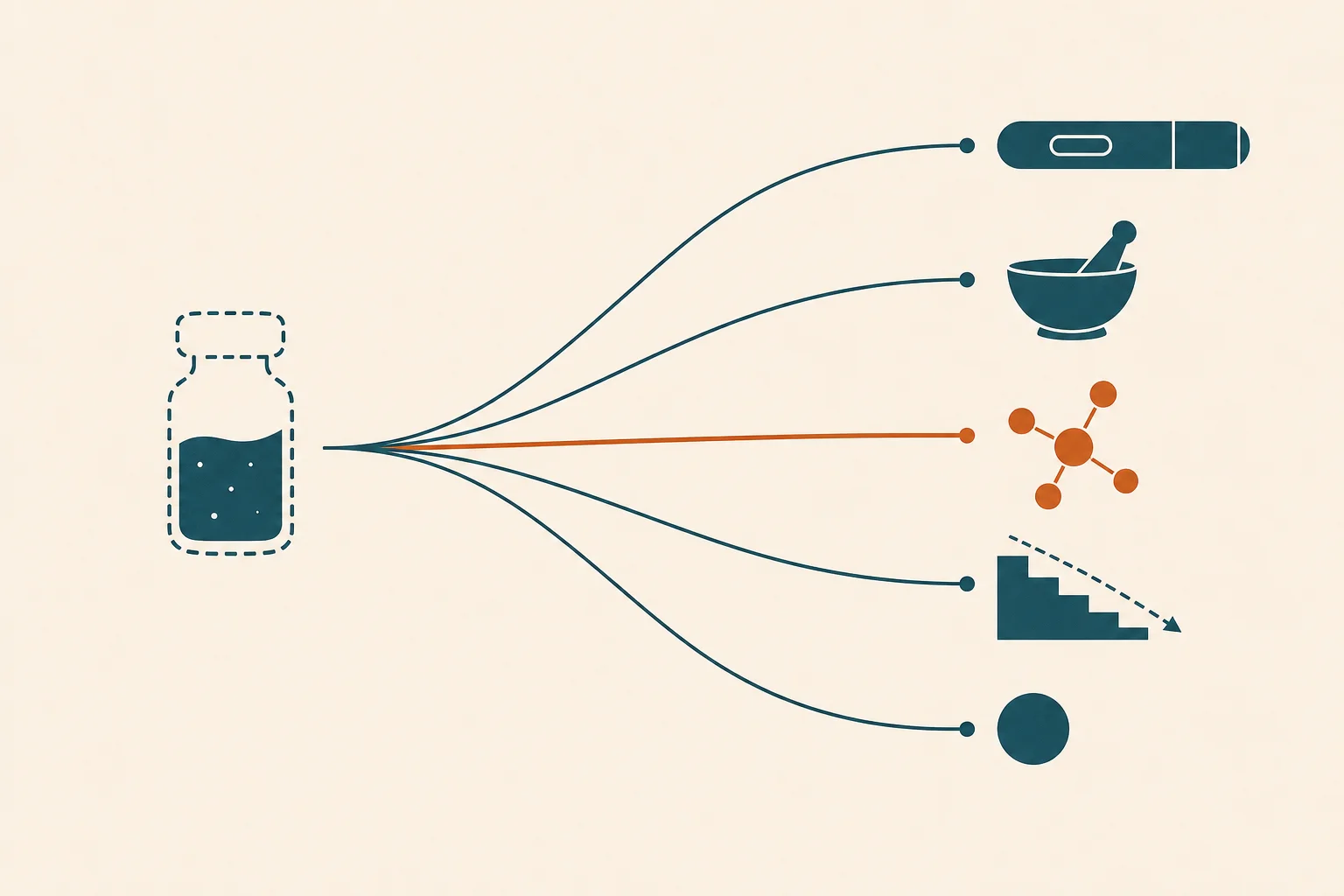
If your provider just cancelled a refill of compounded semaglutide or tirzepatide and told you it is “no longer available,” you are not alone, and you did nothing wrong. For most people the message arrived with no warning and no plan — a cancelled order, a vague note, and a half-empty vial in the refrigerator. This page is the plan.
We are an independent publication, not a telehealth provider. We do not prescribe, dispense, or fulfil orders, and no provider pays us for coverage. What follows is decision support: the five real paths open to you in 2026, what each one costs, and the one administrative step that matters more than any other. For anything clinical — dose, timing, whether to taper — your prescriber is the decision-maker.
First, the 48-hour triage
Before you choose a long-term path, steady the short term.
- Do not panic-buy from the first ad you see. The search results and Reddit threads on this topic are crowded with telehealth marketing, some of it disguised as genuine patient testimonials. A rushed payment is the most common way people get burned here. The riskiest version is buying unregulated “research-grade” peptides sold as a cheap workaround — we explain why that is a different and more serious hazard than anything a licensed pharmacy dispenses.
- Find out exactly how much medication you have left, and ask your prescriber whether to keep taking it on schedule while you transition or to begin spacing doses. That is a clinical call, not one to make from a forum post.
- Pull your records now. Screenshot your provider portal, save your most recent prescription label, and note your current dose and the date you reached it. You will need this for every option below — and especially for the dose-handoff problem we cover further down.
Once that is done, you have time to choose well rather than fast.
Why your compounded prescription went away
The short version: the legal window closed. For about two years, US pharmacies could legally make compounded copies of semaglutide and tirzepatide because FDA had declared both drugs in shortage. FDA declared the tirzepatide shortage resolved on October 2, 2024 and the semaglutide shortage resolved on February 21, 2025, and every enforcement-discretion deadline for compounders expired by May 22, 2025. On April 30, 2026 FDA went further, proposing to keep these drugs permanently off the list that would allow mass-market compounding to resume even in a future shortage.
You do not need the full legal history to make your decision, but if you want it, we keep a dated, sourced account in our GLP-1 compounding-cliff timeline, and a running, automatically updated view of which providers still offer what in our compounding-providers tracker. For the difference between the two compounding frameworks people keep mentioning, see 503A vs 503B compounding explained.
Your five options
There is no single right answer here — the right move depends on your budget, your dose, how you tolerate the drug, and your goals. Here are the five paths, each with the page that covers it in full.
Option 1 — Switch to brand-name Wegovy or Zepbound
This is the path FDA, Novo Nordisk, and Eli Lilly are steering everyone toward, and it is more realistic than it was during the compounded boom because the cash-pay prices have come down. Through Novo Nordisk’s NovoCare Pharmacy, Wegovy cash-pay is $349/month(as of May 2026) a month, with an introductory $199/month for the two lowest doses. Through LillyDirect, Zepbound vials are $299/month for the starter dose, $399/month at 5 mg, and $449/month at higher doses.
The step-by-step move — including the dose mapping from your compounded prescription — is covered in switching from compounded to brand. The enrollment mechanics for each manufacturer pharmacy are in our NovoCare Wegovy enrollment guide and LillyDirect Zepbound enrollment guide.
Option 2 — Move to a provider still compounding compliantly
A smaller number of providers continue to compound under the §503A(b)(1)(D) personalized-dose exception. This pathway is narrower, more expensive than the old mass-market product, and legally contested — but for some patients, particularly those on non-standard doses, it remains an option. The key is verifying that the provider is operating within the exception rather than marketing around it. For the fuller picture of what legitimately remains in 2026 and how to separate a compliant source from a dangerous one, see where to get compounded semaglutide in 2026.
We track the current status of the largest names individually: Hims’s compounded wind-down, Mochi’s compounded status, and Henry Meds’s compounded status. If you are weighing this path, read the vetting section below before you pay anyone, and see switching to a 503B-compliant supply for what a compliant arrangement looks like.
Option 3 — Switch to a different GLP-1
The drug you were on is not the only one in the class. Depending on tolerance, cost, and what your prescriber recommends, an oral option or a different molecule may be a better fit than chasing the same compounded formulation. We lay out the lower-cost routes — including older GLP-1s and oral options — in cheaper GLP-1 alternatives.
Option 4 — Taper off deliberately
If no replacement is affordable or you have decided you are ready to stop, the goal is to do it on purpose rather than by running out. Coming off changes appetite signalling, and the research on weight regain is worth understanding before you decide. Whether and how to taper is a clinical decision for your prescriber, but you can read what the evidence shows in tapering off GLP-1 drugs, stopping Wegovy: what happens, and stopping Zepbound: what happens. If cost is what is forcing you off, coming off as safely as possible when price is the driver is written for exactly that.
Option 5 — Stop, and plan for maintenance
Stopping is a legitimate choice, especially if you have reached your goal. It is not the same as doing nothing: the most-cited data shows a meaningful share of lost weight returns within a year of stopping, and the people who hold their results put a maintenance plan in place first. We cover what the trials actually found, and what tends to help, in weight regain after GLP-1s.
A simple way to choose
If you are stuck between paths, three questions usually settle it.
- Can you afford brand cash-pay at the prices above? If yes, Option 1 is the simplest, most durable, and least legally fraught route. The brand product is the same molecule with none of the regulatory uncertainty.
- If brand is out of reach, is your current dose standard or unusual? A standard dose points toward a cheaper alternative drug (Option 3) or a savings-program conversation. A genuinely non-standard dose is the narrow case where a compliant §503A provider (Option 2) may still have a role — with the vetting below.
- Have you reached the result you wanted? If so, a planned taper (Option 4) or a maintenance stop (Option 5) may matter more than finding any replacement at all.
None of this replaces a conversation with your prescriber. It is a way to walk into that conversation knowing which path you are leaning toward and why.
The dose handoff: the step almost nobody warns you about
Here is the part that the other guides skip, and the one we hear the most anxiety about. When you switch providers, some will continue your current dose and some will restart you at the lowest dose by default — 0.25 mg of semaglutide, or 2.5 mg of tirzepatide — regardless of how far you had titrated. For someone who spent months reaching a maintenance dose, being reset to the starter dose can feel like losing the progress that got them there.
This is avoidable, and it is administrative, not clinical. Before you commit to a new provider:
- Bring documentation of your current dose — the most recent label, pharmacy records, or your old provider’s portal history.
- Ask, in writing, whether they will continue your current dose rather than restarting the titration, and keep their answer.
- Treat a hedge as a yellow flag. A provider who will not say before you pay is telling you something.
We hear this worry constantly from people mid-switch, and it is reasonable: a few minutes of paperwork up front protects months of effort. And if your compounded dose was recorded in units, our guide to converting your units into a weekly milligram dose shows how to put a real number on that documentation before you hand it over.
How to vet a provider before you pay
This corner of the internet is noisy, and not all of the noise is honest. Patients in these communities routinely call out fake “I switched and it’s great” posts as marketing. A genuine provider will withstand two plain questions:
- “Is your pharmacy a state-licensed 503A pharmacy or an FDA-registered 503B outsourcing facility, and what legal pathway are you using now that the shortage is over?” A legitimate operator knows exactly how their workflow complies and will say so.
- “Can you provide a certificate of analysis for my batch?” This is a standard quality document. Reluctance is a warning sign.
Two more red flags worth naming: marketing that calls a compounded product identical to Ozempic or Wegovy — FDA has issued warning letters over exactly that language — and any pressure to pay before your dose-continuation and sourcing questions are answered. When in doubt, slow down. The compounded market is smaller than it was, but it is not the only path, and a provider who earns your trust is worth more than one who rushes it.
How we keep this article current
This page sits on top of a regulatory situation that is still moving, so we treat it as a living document rather than a settled answer. We recheck it monthly and on any FDA filing, federal-court ruling, or major manufacturer price change. The elements most likely to drift between updates:
- The §503A(b)(1)(D) personalized-dose pathway. This is the active legal fault line; a court ruling or final FDA guidance could narrow or close Option 2 with little notice.
- Brand cash-pay prices. The NovoCare and LillyDirect figures above are pulled live from our facts ledger and carry their own “as of” date; they have moved more than once and will move again.
- Which providers still compound. Our compounding-providers tracker is updated automatically; this page links to it rather than freezing a list that goes stale.
If you spot an error or a missing source on this page, email [email protected]. We acknowledge corrections within five business days and publish the resolution within fifteen.
Frequently asked questions
My compounded semaglutide refill was cancelled — does that mean it was unsafe?
Not necessarily. The cancellations are a regulatory consequence, not a recall of your specific medication. The legal authority that let pharmacies mass-produce compounded copies of semaglutide and tirzepatide ended when FDA declared the shortages resolved, so most providers stopped offering it. Separately, FDA has logged hundreds of adverse-event reports tied to compounded GLP-1s, many involving dosing errors from multidose vials — but that is a general safety signal, not a judgement about the vial in your refrigerator. Talk to your prescriber about whether to finish what you have or transition now.
Can I still get compounded semaglutide or tirzepatide anywhere legally in 2026?
In narrow cases. Mass-market compounded copies at standard doses are no longer permitted. Some compounding continues under FDC Act §503A(b)(1)(D), where a state-licensed pharmacist compounds for a specific patient because the prescriber documents that a change from the FDA-approved drug — a non-standard dose, an ingredient allergy, or a justified combination — makes a significant difference for that patient. FDA, Novo Nordisk, and Eli Lilly argue many providers stretch this exception, and the question is being litigated. See our compounding-cliff timeline and provider tracker for the current status.
Will a new provider continue my current dose or make me start over?
It depends on the provider, which is exactly why you should ask before you pay. Some providers follow a fixed protocol that restarts every patient at the lowest dose; others continue your existing titration if you can document it. Bring proof of your most recent fill — the prescription label, pharmacy records, or your provider portal history — and ask in writing whether they will continue your current dose. Get the answer in writing before sending money.
Is brand-name Wegovy or Zepbound affordable now without insurance?
More affordable than during the compounded boom, though still a real expense. Novo Nordisk sells Wegovy cash-pay through its NovoCare Pharmacy, and Eli Lilly sells Zepbound vials cash-pay through LillyDirect, both at flat monthly prices that are well below the brand list price. Our cost pages on NovoCare Wegovy enrollment and LillyDirect Zepbound enrollment walk through eligibility and how to sign up.
What if I genuinely cannot afford any replacement?
That is a common and difficult situation, and it is worth a direct conversation with your prescriber before your supply runs out. Options to discuss include manufacturer savings programs, switching to a lower-cost GLP-1 in the same class, an insurance prior-authorization appeal, or a deliberate, prescriber-supervised taper rather than an abrupt stop. We cover cheaper alternatives and what the research shows about coming off on our after-GLP-1 pages.
How do I know if a telehealth provider's compounding is legitimate?
Ask two questions. First, is the pharmacy a state-licensed 503A pharmacy or an FDA-registered 503B outsourcing facility, and what legal pathway are they using now that the shortage is over? Second, can they provide a certificate of analysis for your batch? A legitimate provider answers both plainly. Vague answers, pressure to pay before those questions are addressed, or marketing that calls the product identical to Ozempic or Wegovy are all warning signs.