Wegovy vs Zepbound: What the Head-to-Head Trial Data Actually Shows
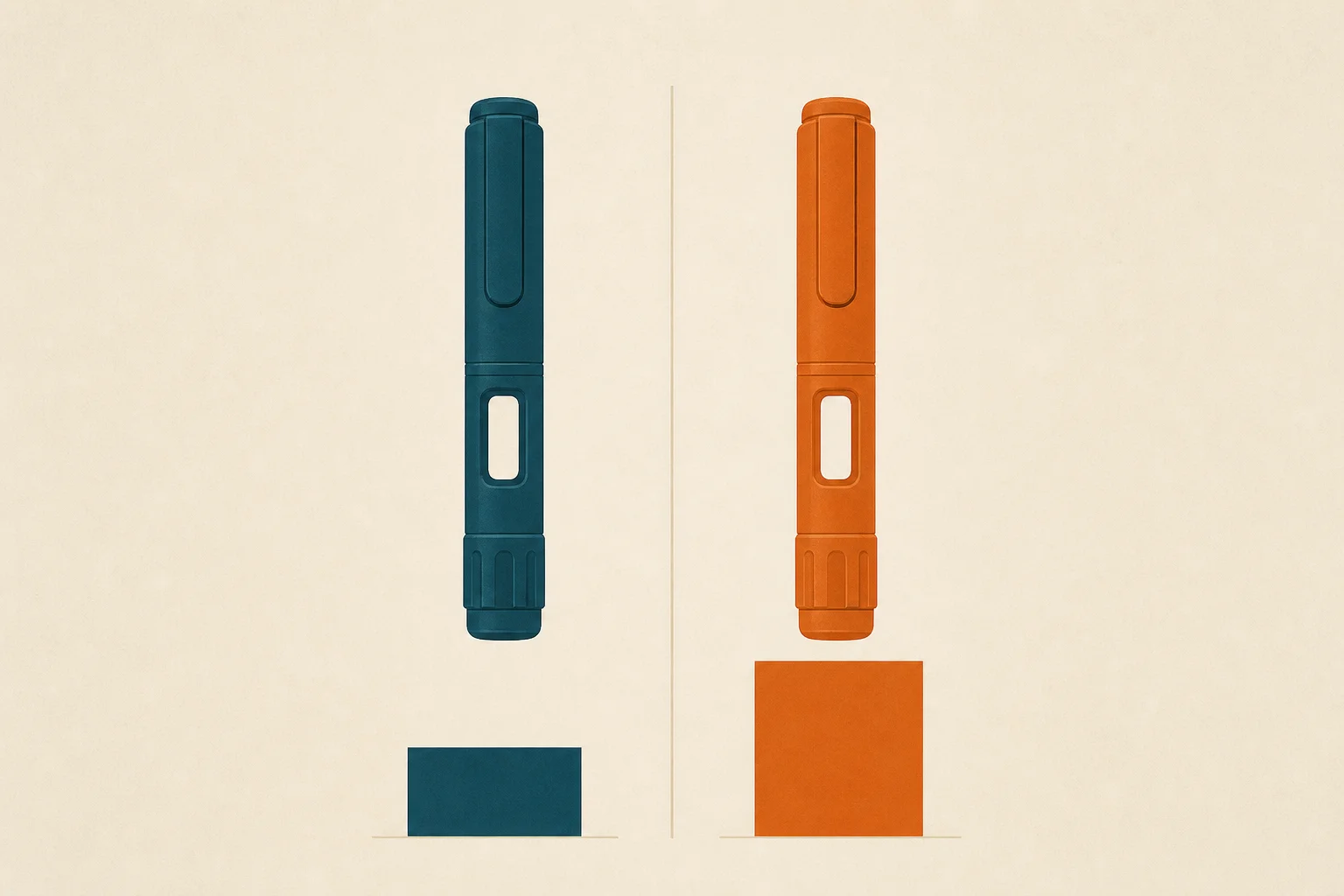
The first head-to-head trial of tirzepatide and semaglutide in obesity, SURMOUNT-5, was published in the NEJM on May 11 2025 (Aronne et al., NEJMoa2416394). The headline number at 72 weeks: mean body-weight reduction of 20.2% with tirzepatide versus 13.7% with semaglutide. A 6.5-percentage-point gap, p<0.001 on the primary endpoint.
That single trial is the most important piece of evidence in this comparison. The rest of this article is what it does not settle, what other trials add, and where the choice still depends on factors no trial measured.
TL;DR
On weight loss alone, the head-to-head data points to tirzepatide. SURMOUNT-5 randomised 751 adults with obesity but without diabetes to the maximum tolerated dose of tirzepatide or semaglutide, and reported 20.2% versus 13.7% mean body-weight reduction at 72 weeks. About 32% of tirzepatide participants lost at least 25% of baseline weight, versus 16%. GI events were common in both arms; discontinuation for GI reasons was higher with semaglutide (5.6%) than tirzepatide (2.7%). Semaglutide, however, has a published CV outcomes trial (SELECT, 2023) and an FDA MACE-reduction indication; tirzepatide does not yet. The right choice for a specific patient depends on comorbidities, cost, insurance, and clinician judgement — not editorial opinion.
The headline trial: SURMOUNT-5
SURMOUNT-5 was a phase 3b, open-label, randomised controlled trial run at 32 US and Puerto Rico sites from April 2023 to November 2024. It enrolled 751 adults with obesity (BMI ≥30, or ≥27 with a weight-related comorbidity) and without type 2 diabetes, randomised 1:1 to weekly subcutaneous tirzepatide or semaglutide titrated to the maximum tolerated dose — 10 or 15 mg for tirzepatide; 1.7 or 2.4 mg for semaglutide — over 72 weeks with a behavioural support programme.
The primary endpoint was percentage change in body weight at week 72. The least-squares mean change was −20.2% with tirzepatide and −13.7% with semaglutide; in absolute terms, 22.8 kg versus 15.0 kg. Waist circumference fell by 18.4 cm versus 13.0 cm. Every prespecified weight threshold favoured tirzepatide — the −25% threshold split 32% versus 16% (Eli Lilly press release; ACC journal scan).
Two caveats. SURMOUNT-5 was funded by Eli Lilly, the manufacturer of tirzepatide — standard for industry head-to-heads, not by itself disqualifying. And the trial was open-label; injectable form factors and titration schedules differ enough to make blinding difficult, but open-label design is a known source of bias in patient-reported outcomes.
The pivotal single-arm efficacy trials
Before SURMOUNT-5, the comparison rested on indirect inference across separate placebo-controlled trials. Those trials remain the regulatory backbone for each drug.
STEP 1 (Wilding et al., NEJM 2021) randomised 1,961 adults with overweight or obesity and without diabetes to weekly semaglutide 2.4 mg or placebo over 68 weeks. Mean weight loss in the semaglutide arm was 14.9% versus 2.4%. That trial supported FDA approval of Wegovy in June 2021.
SURMOUNT-1 (Jastreboff et al., NEJM 2022) randomised 2,539 adults with similar inclusion criteria to weekly tirzepatide at 5, 10, or 15 mg, or placebo, over 72 weeks. Mean weight loss at the 15 mg dose was 22.5% versus 3.1%. That trial supported FDA approval of Zepbound in November 2023.
The cross-trial gap — 22.5% versus 14.9% — was the rough basis for the field's prior belief that tirzepatide produced more weight loss. Different sponsors, different sites, non-identical behavioural-support protocols: exactly the confounding a head-to-head is designed to resolve. SURMOUNT-5's 6.5-percentage-point gap lines up reasonably with the cross-trial gap (about 7.6 points), giving the original inference post-hoc support.
The mechanism difference
The two drugs are different molecules with different targets. Semaglutide binds only the GLP-1 receptor. Tirzepatide is a dual agonist; it binds both the GLP-1 receptor and the receptor for glucose-dependent insulinotropic polypeptide (GIP), the other major incretin hormone.
The clinical relevance of the dual mechanism is still being characterised. GIP activation appears to add complementary effects on lipid handling, central appetite signalling, and adipose tissue function on top of the GLP-1 effects. The most parsimonious explanation for SURMOUNT-5's result is that hitting two receptors does more than hitting one. For how the receptor differences map to the patient experience, see our mechanism guide.
Side-effect profile comparison
In SURMOUNT-5, GI adverse events were the most common AE class in both arms — nausea, diarrhoea, vomiting, constipation. Overall study-drug discontinuation was 8.0% with semaglutide versus 6.1% with tirzepatide; GI-event-driven discontinuation was 5.6% versus 2.7% (ACC summary). Most events were mild to moderate and clustered during dose escalation.
That pattern runs against the assumption that the more potent drug must be worse-tolerated. Within the head-to-head, it was not. The pooled SURMOUNT-1 to -4 tolerability review reported nausea at 24-33% across tirzepatide doses (Rubino et al., DOM 2025); the STEP trials reported nausea at about 44% with semaglutide 2.4 mg. These figures are not directly comparable across separate trials, but the direction matches what SURMOUNT-5 saw at discontinuation. Trial-setting tolerability also tends to be better than real-world telehealth cohorts.
Indications and approval
Both drugs are FDA-approved for chronic weight management in adults with BMI ≥30, or ≥27 with at least one weight-related comorbidity (hypertension, type 2 diabetes, dyslipidaemia, obstructive sleep apnoea). Both are approved for adolescents 12 and older with obesity.
The indications diverge on cardiovascular labelling. Wegovy carries an FDA indication for reducing major adverse cardiovascular events in adults with established CVD and overweight or obesity without diabetes — added after the SELECT readout. Zepbound has no analogous indication yet; SURMOUNT-MMO is still running. Both molecules are also FDA-approved for type 2 diabetes under different brands: semaglutide as Ozempic, tirzepatide as Mounjaro. Same molecules; different doses, different indications. The FDA prescribing labels are public (Wegovy; Zepbound).
Dosing schedules
Wegovy titrates over about 16 weeks: 0.25 mg weekly for four weeks, then 0.5 mg, 1 mg, 1.7 mg, and finally a maintenance dose of 2.4 mg, four weeks at each step. Slower titration is allowed at prescriber discretion if GI symptoms are difficult.
Zepbound titrates over about 20 weeks: 2.5 mg, then 5, 7.5, 10, 12.5, and 15 mg, again four weeks at each step. The starting and maximum doses are different orders of magnitude (2.5-15 mg versus 0.25-2.4 mg) because the molecules differ in per-milligram potency; doses are not comparable across drugs. Both are weekly subcutaneous injections via prefilled single-dose pens or multi-dose vials (LillyDirect vials for Zepbound; NovoCare Pharmacy for Wegovy).
Cost (May 2026)
List prices have moved substantially in the past year. As of May 2026, Wegovy is $349/month cash pay through Novo Nordisk's NovoCare Pharmacy, with a $199/month introductory rate for the two lowest doses. Zepbound vials through LillyDirect are $299/month (2.5 mg starter), $399/month (5 mg), and $449/month (7.5 mg and above). Insurance coverage varies; commercial insurers increasingly cover one drug but not the other at the same tier. For the full breakdown see Wegovy cost without insurance and Zepbound cost through LillyDirect; these numbers change frequently and live there.
Cardiovascular outcomes data
Semaglutide has a completed cardiovascular outcomes trial. SELECT (Lincoff et al., NEJM 2023) randomised 17,604 adults with established CVD and overweight or obesity but without diabetes to weekly semaglutide 2.4 mg or placebo, mean follow-up 39.8 months. The primary composite — CV death, non-fatal MI, or non-fatal stroke — was reduced by 20% (HR 0.80; 95% CI 0.72-0.90; absolute event rates 6.5% versus 8.0%). The result supported FDA approval of Wegovy's MACE-reduction indication in March 2024.
Tirzepatide has no equivalent published trial. SURMOUNT-MMO (NCT05556512), the analogous tirzepatide outcomes trial, enrolled approximately 15,000 adults with obesity and established CVD or high CV risk; it is scheduled to read out in 2027. Until then, the cardiovascular evidence base favours semaglutide for patients whose primary clinical concern is CVD. For a patient with BMI 32, prior MI, and no diabetes, the existing evidence makes a clearer case for Wegovy — not because tirzepatide has been shown to lack CV benefit, but because it has not yet been shown to have one.
The honest comparison summary
On mean weight loss over 72 weeks at maximum tolerated dose, the head-to-head data points to tirzepatide. The gap is real, statistically significant, and consistent across every clinically meaningful threshold.
On cardiovascular outcomes evidence, semaglutide has a completed trial with a 20% MACE reduction and an FDA indication; tirzepatide does not yet.
On side-effect tolerability within the only head-to-head, semaglutide had numerically higher discontinuation for GI events than tirzepatide — the opposite of what cross-trial assumptions had suggested.
Both drugs are highly effective versus placebo. Both have similar BMI thresholds. Both are weekly subcutaneous injections at broadly similar cash-pay prices. The choice for a specific patient depends on established CVD status, insurance tier, tolerability, and the prescriber's judgement on comorbidities and drug interactions. We do not have a preference between the two products and do not sell them.
For patients thinking about coming off, see stopping Wegovy: what happens and stopping Zepbound: what happens. For compounded versions of either drug, see the compounded vs brand explainer.
How we keep this article current
We refresh this page on every new SURMOUNT or STEP readout, every relevant FDA action, and every CV outcomes result. A head-to-head comparison like this moves as new trial data lands and prices shift, so a few things tend to drift faster than the rest:
- Cardiovascular outcomes evidence. SURMOUNT-MMO, the tirzepatide CV outcomes trial, is expected to read out in 2027; a positive result would close the evidence gap and remove the strongest current reason to prefer semaglutide in CVD patients.
- Adjacent-population data. Additional SURMOUNT trials in adjacent populations (HFpEF, OSA, MASLD) are reading out across 2026 and 2027 and may broaden the indications.
- The next-generation pipeline. Retatrutide — Lilly's triple agonist hitting GLP-1, GIP, and glucagon — is in Phase 3. Its Phase 2 readout reported about 24% weight loss at 48 weeks, the highest figure in the class. If Phase 3 confirms, retatrutide could displace both products on weight loss alone within two to three years.
- Cash-pay prices and coverage. List prices and insurer tiers for both drugs change frequently and live on our dedicated cost pages.
Errors or missing sources: email [email protected].
Methodology: this article compares two FDA-approved GLP-1 receptor agonist drugs using published clinical trial data, FDA prescribing labels, and manufacturer disclosures. It does not constitute medical advice and is currently awaiting medical-reviewer signoff. When that review is complete, clinical claims will be reviewed, signed, and dated by a named MD. See our methodology page and the editorial policy linked there.
Frequently asked questions
Which works better for weight loss, Wegovy or Zepbound?
In SURMOUNT-5 (NEJM, May 2025) — the only head-to-head trial published to date — tirzepatide produced a mean 20.2% body-weight reduction at 72 weeks versus 13.7% for semaglutide. About 32% of tirzepatide participants lost at least 25% of baseline weight, versus 16% for semaglutide. On weight loss alone, the data points to tirzepatide. That does not automatically mean it is right for every patient: comorbidities, cost, and side-effect tolerance vary.
Is Zepbound just a stronger version of Wegovy?
No. They are different molecules with different receptor targets. Semaglutide binds only the GLP-1 receptor. Tirzepatide is a dual agonist that binds both the GLP-1 and GIP receptors. The added GIP activity is the mechanistic explanation most often offered for the greater weight loss observed in SURMOUNT-5. The drugs are not interchangeable doses of the same compound.
Are side effects worse on Zepbound or Wegovy?
In SURMOUNT-5, GI events were common in both arms but treatment discontinuation for GI reasons was higher with semaglutide (5.6%) than tirzepatide (2.7%). Overall study-drug discontinuation was 8.0% versus 6.1%. That runs against the assumption that the more potent drug must be worse tolerated. Individual experience varies; titration speed matters more than drug choice for many patients.
Does Wegovy have better cardiovascular evidence than Zepbound?
At present, yes. SELECT (Lincoff et al., NEJM 2023) showed semaglutide 2.4 mg reduced major adverse cardiovascular events by about 20% over a mean 39.8 months in patients with established CVD and overweight or obesity but no diabetes. Tirzepatide's analogous trial, SURMOUNT-MMO, is ongoing and not expected to read out until 2027. For patients with established CVD and no diabetes, semaglutide currently has the stronger CV evidence base.
Are Wegovy and Zepbound approved for the same patients?
The FDA indications are very similar. Both are approved for chronic weight management in adults with BMI ≥30, or ≥27 with at least one weight-related comorbidity. Wegovy is also approved to reduce MACE in adults with established CVD and overweight or obesity without diabetes — an indication Zepbound does not yet have. Both have pediatric labelling for adolescents 12 and older.
What about Ozempic and Mounjaro?
Same active ingredients, different brands, different indications. Ozempic is semaglutide (same molecule as Wegovy) at lower doses, FDA-approved for type 2 diabetes. Mounjaro is tirzepatide (same molecule as Zepbound), also approved for type 2 diabetes. Coverage, list price, and prescribing rules vary by brand and indication; the molecule does not.
If a patient does not tolerate one, can they switch to the other?
Switching is clinically routine, though the literature on optimal cross-titration is thin. Both drugs hit the GLP-1 receptor, so cross-tolerance is partial; some patients tolerate tirzepatide after stopping semaglutide for GI reasons, and the reverse also happens. There is no validated dose-equivalency table; most prescribers re-titrate from a low dose on the new drug regardless of prior maintenance dose. SURMOUNT-5 did not study switching.