GLP-1 Drugs and Liver Health: What the Evidence Shows for NAFLD and NASH
Why liver health is directly relevant to GLP-1 therapy
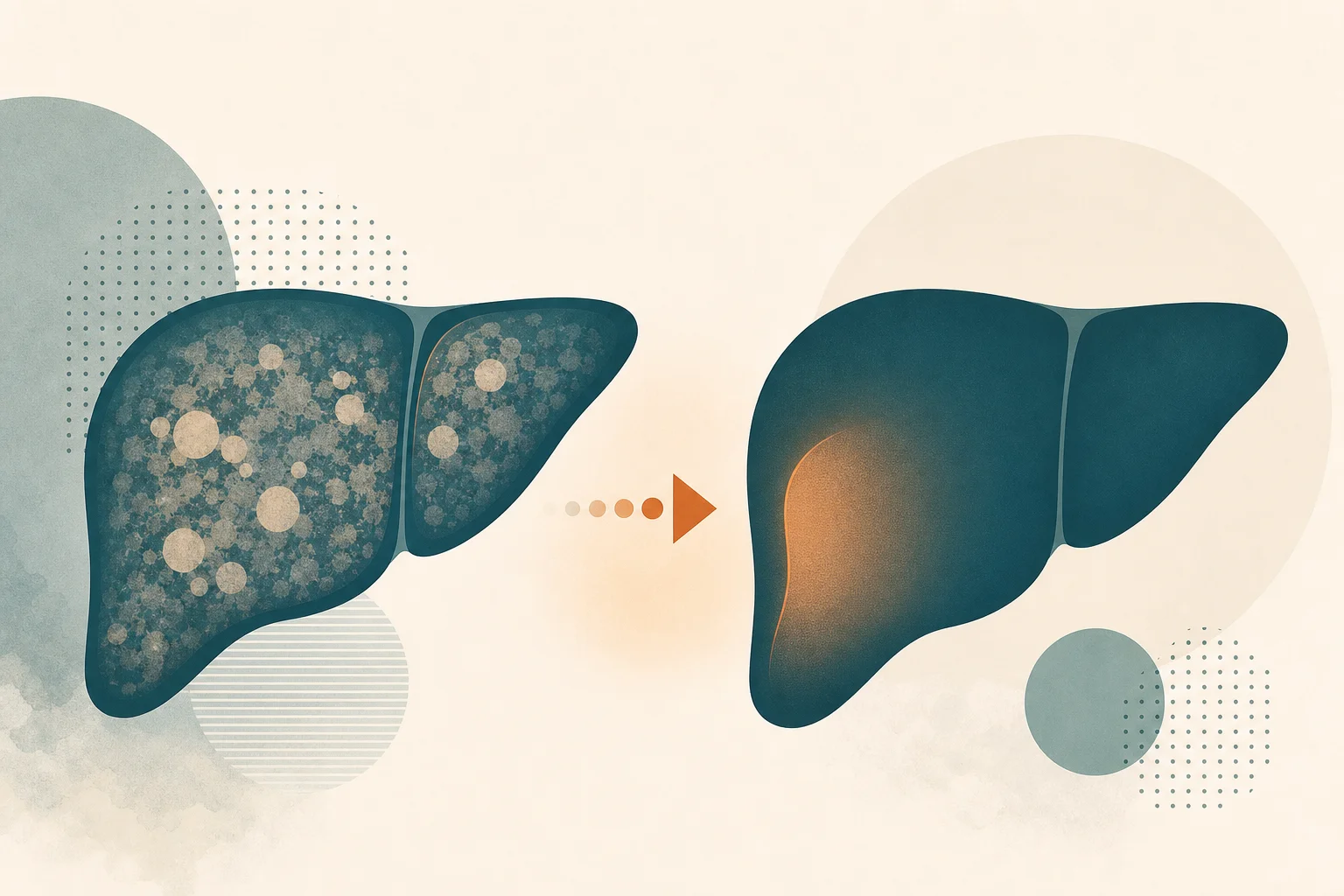
Non-alcoholic fatty liver disease (NAFLD) is the most common liver condition worldwide, affecting approximately 25–30% of the global population and up to 80% of patients with type 2 diabetes or obesity. NAFLD exists on a spectrum:
- Simple steatosis: Fat accumulation in the liver without significant inflammation. Usually asymptomatic and reversible.
- Non-alcoholic steatohepatitis (NASH): Fat accumulation plus lobular inflammation and hepatocyte injury. NASH can progress to fibrosis, cirrhosis, and hepatocellular carcinoma.
Many patients prescribed GLP-1 drugs for weight loss or T2D have concurrent NAFLD or NASH, often undiagnosed. Understanding what GLP-1 therapy does to liver fat is clinically relevant.
The mechanism: how GLP-1 agonists affect the liver
GLP-1 receptors are expressed in the liver, though at lower density than in the pancreas, brain, and gut. The hepatic effects of GLP-1 agonism appear to be both direct and indirect:
Direct effects:
- Activation of hepatic GLP-1 receptors reduces hepatic fat synthesis (de novo lipogenesis)
- Anti-inflammatory signalling reduces hepatocyte stress responses
Indirect effects (more significant):
- Weight loss reduces the hepatic fat burden driven by obesity and insulin resistance
- Improved insulin sensitivity reduces the hyperinsulinaemia that drives hepatic fat accumulation
- Reduced visceral adiposity specifically decreases portal lipid flux to the liver
The indirect effects likely dominate in clinical outcomes, but there is evidence for a weight-loss-independent component — patients who achieve similar weight loss through lifestyle alone show less NAFLD improvement than those who achieve it through GLP-1 therapy, suggesting a drug-specific effect exists.
What the trial data shows
Semaglutide (LEAN and NASH trials)
LEAN trial (2016): The first RCT of a GLP-1 agonist specifically in NASH. Liraglutide 1.8 mg daily vs placebo in 52 NASH patients over 48 weeks. 39% of liraglutide patients achieved NASH resolution (vs 9% placebo). Significant reductions in liver fat (MRI-measured).
ESSENCE trial (semaglutide 2.4 mg, NASH): Phase 3 trial results published in 2023-24 showed semaglutide 2.4 mg achieved NASH resolution without worsening fibrosis in significantly more patients than placebo at 72 weeks. This established semaglutide as having clinically meaningful NASH activity.
Key finding: Semaglutide 2.4 mg is the most studied GLP-1 agent in NASH with Phase 3 data supporting liver histological improvement, not just biomarker or imaging improvement.
Tirzepatide (SYNERGY-NASH trial)
The SYNERGY-NASH Phase 2 trial (2024) showed tirzepatide at all doses (5, 10, 15 mg) produced substantial NASH resolution and fibrosis improvement compared to placebo. 62% of patients on tirzepatide 15 mg achieved NASH resolution without worsening fibrosis, compared to 10% on placebo. This effect was larger than seen in comparable semaglutide trials.
Phase 3 NASH data for tirzepatide is ongoing but early evidence suggests it may be the most effective GLP-1-class agent for liver disease specifically, consistent with its superior weight loss data overall.
Liver biomarkers to monitor
ALT (alanine aminotransferase) and AST (aspartate aminotransferase) are the standard liver enzyme markers. In NAFLD/NASH:
- ALT typically elevated (often 1.5–3× upper limit of normal in active NASH)
- Normalisation or improvement of ALT is a reliable indirect marker of liver fat reduction
Most patients on GLP-1 therapy see ALT improvement within 12–24 weeks, correlating with MRI-measured fat reduction. ALT normalisation is not a diagnostic endpoint (liver biopsy or MRI-PDFF remains gold standard) but it is a practical monitoring tool.
FIB-4 score (fibrosis-4 index, calculated from AST, ALT, platelets, age) is a non-invasive fibrosis staging tool. FIB-4 under 1.30 suggests low fibrosis risk; above 2.67 suggests high risk and warrants liver biopsy referral. Monitoring FIB-4 over time on GLP-1 therapy can track fibrosis trajectory.
Who should receive specific monitoring
Patients at highest risk for advanced NAFLD/NASH who warrant formal liver assessment:
- T2D patients with consistently elevated ALT (more than twice the upper limit of normal)
- Patients with metabolic syndrome (obesity + hypertension + dyslipidaemia + glucose impairment)
- Patients with unintentional weight loss (a paradoxical NASH progression trigger)
- Patients with thrombocytopenia (low platelets), which can indicate portal hypertension from cirrhosis
- Family history of cirrhosis or hepatocellular carcinoma
First-line assessment: AST, ALT, platelet count → FIB-4 calculation. FIB-4 above 1.30 warrants referral for liver ultrasound ± fibroscan. FIB-4 above 2.67 warrants hepatology referral.
The fibrosis question: does GLP-1 therapy reduce fibrosis?
Reduction in liver fat and inflammation (NASH resolution) is well evidenced. The fibrosis question is harder — fibrosis reversal requires hepatic stellate cell deactivation and is slower and harder to achieve than inflammation resolution.
Current evidence:
- ESSENCE (semaglutide): liver fibrosis improved by at least one stage in approximately 30% of patients on semaglutide vs 15% on placebo at 72 weeks
- SYNERGY-NASH (tirzepatide): 55% fibrosis improvement (at least 1 stage) in tirzepatide 15 mg arm vs 35% placebo
These are not "reversal" rates — most patients with significant fibrosis do not fully resolve it within 72 weeks. But the direction is positive, and the fibrosis reduction data is among the strongest ever seen in a drug trial for NASH.
Practical takeaways for GLP-1 patients
-
If you have T2D, obesity, or metabolic syndrome, you likely have some degree of liver fat. GLP-1 therapy is treating that too, even if liver disease was not the original indication.
-
Baseline liver function tests (LFTs) and FIB-4 calculation at GLP-1 initiation are appropriate for patients with metabolic risk factors.
-
ALT improvement during therapy is a useful indirect marker of progress.
-
If you have known NAFLD or NASH, discuss the evidence above with your prescriber — semaglutide 2.4 mg has Phase 3 data specifically for NASH, not just obesity.
-
Weight-loss speed matters. Rapid weight loss (more than 1.5 kg/week) can paradoxically worsen liver disease by flooding the portal system with mobilised fats. GLP-1-assisted weight loss at its natural pace is less likely to cause this than crash dieting.
Summary
GLP-1 receptor agonists — semaglutide and tirzepatide particularly — produce clinically meaningful reductions in liver fat, inflammation, and early fibrosis in patients with NAFLD and NASH. The liver effects appear partially independent of weight loss, suggesting direct hepatic GLP-1 receptor activity contributes. Semaglutide 2.4 mg has the most robust Phase 3 NASH trial data; tirzepatide Phase 2 data suggests potentially greater efficacy. Baseline liver function tests and FIB-4 monitoring are appropriate for metabolically high-risk patients starting GLP-1 therapy.
This article is queued for review by a medical doctor. It should not be used as personal medical advice.
Part of GLP-1 Benefits Beyond Weight Loss — the evidence for GLP-1 drugs across heart, kidney, metabolic, and other outcomes.